
A YouTube behavior analyst is not just someone who opens YouTube Studio, checks the view count, and says a video performed well. In a creator or livestreaming context, the phrase makes more sense as a practical role: someone who studies how viewers find, watch, leave, return, comment, and react to content.
That is different from being a basic analytics reader. A basic reader looks at numbers after the stream ends. A behavior analyst tries to understand the pattern behind those numbers. Why did viewers join at that moment? Why did they leave after the intro? Why did one live topic create chat activity while another stayed quiet? Why did a thumbnail get clicks but fail to hold attention?
For Trending Livestream Sound of Text, this topic belongs in the Behavior category because the real issue is viewer action. Platforms change, tools change, and trends move fast, but audience behavior is still the thing creators must learn to read.
A Basic Analytics Reader Watches Numbers After The Fact
A basic analytics reader usually starts with surface metrics. They check views, likes, comments, subscribers, impressions, and maybe average view duration. These numbers are useful, but they are only the beginning.
Basic Reading Shows What Happened
Basic analytics can answer simple questions such as:
- How many people watched?
- How long did they watch?
- Did the stream gain subscribers?
- Did the thumbnail get clicks?
- Did the live session reach a peak audience?
- Did viewers comment or react?
- Did the replay continue getting traffic?
YouTube’s Audience tab gives creators an overview of who is watching their videos and includes insights such as demographics, new viewers, and subscribers. YouTube also notes that some data, such as geography, traffic sources, or gender, may be limited in Analytics.
This level of reading is useful, especially for beginners. It helps creators notice whether a video or live stream is growing, flat, or underperforming.
Basic Reading Often Stops Too Early
The weakness is that basic readers often stop at the number itself.
They may say:
- “This stream got fewer views.”
- “This video had better CTR.”
- “This topic gained subscribers.”
- “This live had more comments.”
- “This replay did not perform.”
Those statements are not wrong, but they are incomplete. The creator still needs to know why the pattern happened and what to change next.
A basic reader sees a drop. A behavior analyst asks what happened right before the drop.
A YouTube Behavior Analyst Studies Viewer Decisions
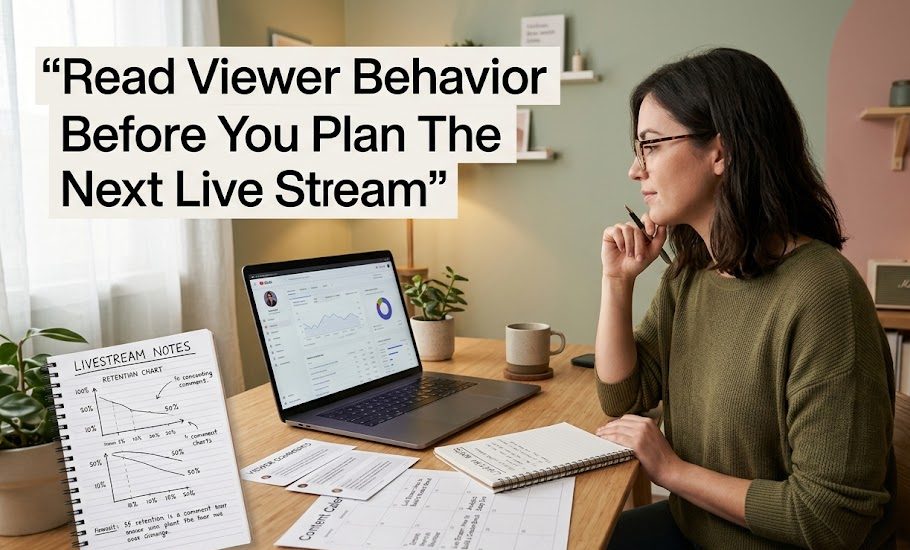
A YouTube behavior analyst looks at the stream as a series of viewer decisions. Every click, pause, skip, comment, return, and exit says something about audience behavior.
Behavior Analysis Looks For Patterns
A behavior-focused creator does not treat each video as an isolated result. They compare patterns across content.
They ask:
- Which topics bring new viewers?
- Which formats bring returning viewers?
- Which intros lose attention fastest?
- Which live titles create reminders?
- Which segments create chat activity?
- Which thumbnails bring clicks but weak watch time?
- Which topics create loyal viewers instead of one-time traffic?
YouTube explains that its Audience tab can help creators understand who is watching, how viewers interact with content, and how often they come back to a channel. It also groups viewers into new, casual, and regular viewers to help creators understand audience loyalty.
That is exactly where behavior analysis becomes more useful than simple reporting. It connects audience type with content choices.
Behavior Analysis Treats Retention As A Story
Retention is not only a line on a chart. It is a viewer story.
If viewers leave during the first minute, the intro may be too slow.
If viewers stay during the demo, the practical section may be strong.
If viewers return during a specific explanation, the topic may be worth turning into another stream.
If viewers drop during a long sponsor section, the placement may be wrong.
YouTube’s content performance reports include views, average view duration, impressions, impressions click-through rate, and key moments for audience retention, which show how well different moments held viewer attention.
A behavior analyst uses those moments to improve the next content plan, not just to judge the old one.
The Difference Is Not The Tool But The Question
Both a basic analytics reader and a YouTube behavior analyst may open the same dashboard. The difference is the question they ask.
| Area | Basic Analytics Reader | YouTube Behavior Analyst |
|---|---|---|
| Views | Counts how many people watched | Asks where viewers came from and why they clicked |
| CTR | Checks whether the thumbnail worked | Compares CTR with watch time to detect weak promises |
| Retention | Notices where viewers dropped | Studies what content moment caused the exit |
| Live metrics | Checks peak viewers | Studies what segment created the peak |
| Comments | Counts engagement | Groups comments into questions, objections, and topic signals |
| Returning viewers | Sees loyalty as a number | Studies which format brings people back |
| Upload timing | Posts when convenient | Uses audience activity and behavior patterns |
| Trend response | Copies what is popular | Checks whether the trend matches audience habit |
This is why the behavior analyst approach is stronger for creators who want repeatable growth. It does not only say what performed. It explains what viewer behavior is trying to show.
CTR Without Retention Can Mislead Creators
Click-through rate can make creators overconfident. A strong title or thumbnail may bring viewers in, but that does not mean the content satisfied them.
Basic Readers Celebrate The Click
A basic reader may see a high CTR and think the packaging worked. That can be true, but it can also hide a problem.
A thumbnail can create curiosity. A title can create urgency. A live topic can look trending. But if viewers leave quickly, the click did not turn into trust.
Behavior Analysts Compare Clicks With Watch Quality
A behavior analyst compares CTR with watch time, retention, and viewer satisfaction signals. YouTube’s impressions and CTR guidance says clickbait can create high CTR but low average view duration, and videos with high CTR but low average view duration may be less likely to get recommended.
That point matters for livestreaming too. A creator can attract people with a dramatic title, but if the live session does not deliver quickly, viewers leave.
The sharper reading is this: a click is not proof of success. A click is only the first yes. Retention shows whether viewers kept saying yes.
Live Streams Need Behavior Analysis More Than Normal Uploads
Livestreams are more unpredictable than edited videos. Viewers join late, leave early, ask questions, react in real time, and behave differently depending on timing, topic, and chat energy.
Basic Live Metrics Show Stream Health
YouTube live metrics include average concurrent viewers, peak concurrent viewers, key moments for audience retention, reactions, and reminders set.
These metrics are useful because a live stream is not only about total views. A stream can have a modest total view count but strong live engagement. Another stream can have many replay views but weak live participation.
Behavior Analysts Study The Live Room Rhythm
A behavior analyst looks at the flow of the live session.
They ask:
- When did viewers join fastest?
- What topic created the highest peak?
- Did the intro delay the real value?
- Did viewers react more to demos or opinions?
- Did chat become active after a question?
- Did people leave during technical explanations?
- Did reminders turn into actual attendance?
- Did the replay perform better than the live moment?
This matters because live content has rhythm. A boring first five minutes can weaken the whole session. A strong middle segment can create clips, replay value, and future topic ideas.
Audience Loyalty Is More Valuable Than One Lucky Spike
A trend can bring a temporary spike, but loyalty keeps the channel alive after the trend moves on.
Basic Readers Notice Subscriber Growth
A basic reader may focus on subscriber gain after a video or live stream. That is useful, but subscribers alone do not explain whether viewers will return.
A channel can gain subscribers from one viral topic and still struggle to bring those people back.
Behavior Analysts Separate New, Casual, And Regular Viewers
YouTube’s Audience guidance discusses new, casual, and regular viewers as a way to understand how people return to a channel. It also explains that unique viewers can help creators understand audience size across a time period, even when someone watches on different devices or watches more than once.
That distinction matters. A creator should not treat every viewer the same.
New viewers need context.
Casual viewers need stronger reasons to return.
Regular viewers need consistency and recognition.
For livestream creators, this can shape the whole format. A stream built only for loyal viewers may confuse new viewers. A stream built only for new viewers may bore the regular audience.
Comments Are Not Just Engagement
Comments are often treated as a number. A behavior analyst treats them as audience language.
Basic Readers Count Comments
A basic reader may say a live stream did well because it had many comments. That can be true, but comment volume alone does not explain quality.
A chat can be active because viewers are confused.
A comment section can grow because people disagree.
A stream can have fewer comments but stronger buyer intent or topic clarity.
Behavior Analysts Group Comment Intent
A behavior analyst reads comments in groups:
- repeated questions
- confusion points
- objections
- requests for examples
- emotional reactions
- topic suggestions
- trust concerns
- product or tool questions
- requests for future livestreams
This gives the creator a better next step. If ten viewers ask the same question, that question may deserve a short video, a future live session, or a clearer explanation in the next stream.
The Better Role For Trending Content
Trending livestreams move fast. A creator cannot analyze forever before acting. But moving fast does not mean guessing.
Basic Readers Chase Trends
A basic reader may see a topic performing well and immediately copy it. This can work once, but it often creates weak content because the creator does not know why the trend worked.
They copy the surface:
- title style
- topic angle
- thumbnail format
- live timing
- creator behavior
- platform trend
But they miss the audience reason.
Behavior Analysts Ask Whether The Trend Fits
A YouTube behavior analyst asks whether the trend matches the channel’s actual viewers.
They ask:
- Does this trend fit returning viewers?
- Will new viewers understand the channel after clicking?
- Can the creator add a useful angle?
- Will the topic create retention or only curiosity?
- Does this trend help the next three uploads?
- Will the livestream chat have something meaningful to discuss?
This is sharper than trend-chasing. It filters hype through audience behavior.
A Practical Behavior Analyst Workflow
A creator does not need to be a data scientist to use this approach. The workflow can stay simple.
Before The Stream
Check:
- top videos from the last 90 days
- returning viewer topics
- audience active times
- previous live retention
- questions from comments
- topics with strong replay value
- thumbnails with high CTR and strong watch time
- live sessions with high peak concurrent viewers
Then decide:
- one clear promise
- one primary audience
- one opening hook
- one main segment
- one chat interaction plan
- one replay value angle
During The Stream
Watch:
- when viewers join
- when chat wakes up
- when people ask repeated questions
- when energy drops
- when the host talks too long without value
- when viewers request links, examples, or demos
- when reactions increase
Do not panic over every movement. Look for meaningful changes.
After The Stream
Review:
- peak concurrent viewers
- average concurrent viewers
- retention moments
- replay views
- comments
- new versus returning viewer behavior
- subscriber change
- traffic source
- click-through and watch time relationship
Then write one decision for the next stream:
- shorten the intro
- move the demo earlier
- split the topic into two streams
- make a beginner version
- create a follow-up clip
- change the title promise
- repeat the format with a better angle
Q&A
What Does A YouTube Behavior Analyst Do?
A YouTube behavior analyst studies how viewers behave around content. That includes clicks, retention, comments, returning viewers, live attendance, reactions, and drop-off moments. The goal is to understand why viewers act a certain way, not only whether the video got views.
Is A YouTube Behavior Analyst The Same As A YouTube Analytics Expert?
Not exactly. A YouTube Analytics expert may focus on reading dashboard metrics. A YouTube behavior analyst goes further by connecting those metrics to viewer decisions, content structure, timing, topic fit, and livestream format.
Which Metrics Matter Most For YouTube Livestreams?
Useful livestream metrics include peak concurrent viewers, average concurrent viewers, retention moments, reactions, reminders set, comments, replay performance, and returning viewer behavior. YouTube’s live metrics documentation includes average and peak concurrent viewers, retention moments, reactions, and reminders set.
Can Small Creators Use Behavior Analysis?
Yes. Small creators may even benefit more because they can notice viewer patterns early. They do not need complex tools. They can start by comparing titles, retention drops, repeated comments, returning viewers, and which live topics create real conversation.

Nadira Wicaksana is a former social media listening analyst who has monitored creator trends, viral broadcasts, platform updates, and audience conversations across Southeast Asia. She has worked with digital agencies and consumer brands to identify new livestream formats before they become widely adopted. Her articles examine what is gaining attention, why audiences respond to it, and whether a trend has lasting value or is simply passing noise.



1 comment
Comments are closed.